
CHOOSING THE RIGHT STICK
One of the most important choices a drummer must do is the choice of sticks. This is not just done in an eyewink due to playing style and of course, style of Music. Here´s the tip of the day.
The drumstick choice is a personal affair and all manufacturers has their own sizes/models and even though there are no standards, almost everyone follows these guidelines. All drumsticks have a number followed by a letter. This is a guide to help you to the style of Music and heaviness in the drumstick which in the next step will effect your performance. Important to say, this is just a recommendation so, you should look at it as a curious but good to know information. Lets have a go:
The Letters first:
S=Street; Heavy performance stick originally made for marchingdrums.
B=Band; Lighter sticks for brass and symphonic Orchestras for greater performance yet high in striking volume.
A=Orchestra; most suitable for bigbands and dance Orchestras were the drums are to be held back in volume but fast in action when needed.
Then we got the numbers:
The numbers indicate the diameter of the drumstick. The higher the number, the thinner the stick. Most popular models are: 7A, 7B, 5A, 5B and 2B. The 7A is the thinnest and therefore the fastest stick. 5B is the most common stick in rockbands due to its high durability and volume but its more heavier to play. 2B is the most volume strong stick but hard to play fast and to be technical with. Uncertain of choice? Start to play with 5A or 5B and work your way from there, a good compromise.
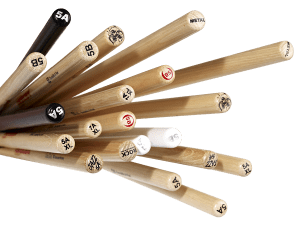
The next thing to take in considoration, is the tip of the stick.
 Round
Round  Oval
Oval  Triangel
The round tip will give you a small striking area which gives you a small variation of flexibility in tone.Basically it sounds the same all the time. The Oval shape gives you a greater variation of flexibility between dark and light tones due to greater striking area. Good to know when you need to change tone in cymbal playing. And then there´s the Triangel. The most variated shape between dark and high tones. A personal favorite. You have to explore your style and of course what you are playing.
Material
The drumstick is often made by different choice of Wood. Hickory, Maple or Oak is the most common ones. Then there´s the choice of glossy or not?? As you can see there´s a lot of choices to be made and do try to have patience as this is the first thing that interferes with your playing!!
Need more info? Of course you do. 🙂
Follow the link and get on with you´re prefered drumstick! Enjoy…
http://www.mikedolbear.co.uk/story.asp?StoryID=459&Source=Arch



 Vinylanddrums